
A business owner may hear the words General Liability and Professional Liability and assume they protect against the same things.
They do not.
The easiest way to think about the difference is:
General Liability helps protect your business when someone is physically injured or their property is damaged.
Professional Liability helps protect your business when a customer claims your professional service, advice, or mistake caused them financial harm.
Depending on what your business does, you may need one—or both.
Imagine Two Different Claims
Suppose you own a consulting business.
A client visits your office, trips over an extension cord, falls, and is seriously injured.
That is the type of claim General Liability Insurance is designed to address.
Now imagine a different situation.
Your business gives a client professional advice. The client follows that advice, loses a significant amount of money, and claims your recommendation caused the loss.
Nobody was physically injured.
Nothing was physically damaged.
But the client believes your professional service caused financial harm.
That is where Professional Liability Insurance may come into play.
Two claims.
Two completely different risks.
What Does General Liability Cover?
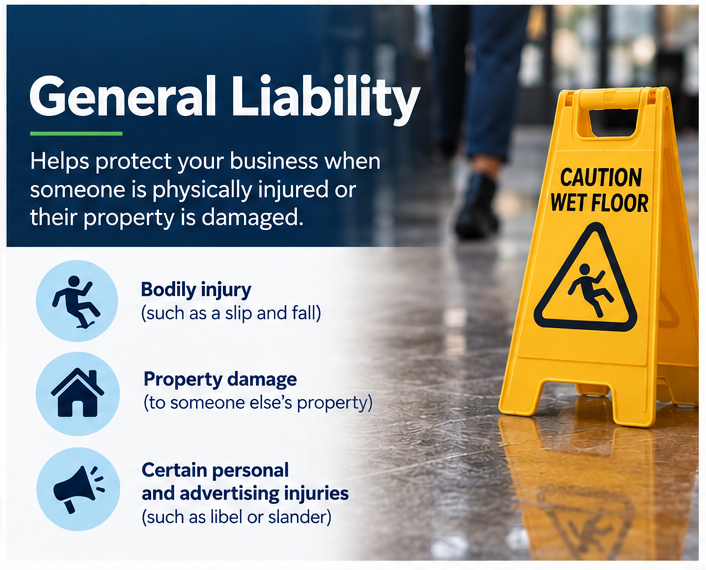
Commercial General Liability—often called CGL or General Liability Insurance—is designed to protect businesses against certain claims involving things such as:
Bodily injury
Damage to someone else's property
Personal injury, such as certain libel or slander claims
Certain advertising injuries
For example, imagine your employee accidentally damages a customer's property while completing a job.
Or a customer slips and falls inside your business.
Those are the types of situations General Liability may help protect against.
The National Association of Insurance Commissioners describes General Liability as coverage for claims involving bodily injury, property damage, and certain personal or advertising injuries.
What Does Professional Liability Cover?
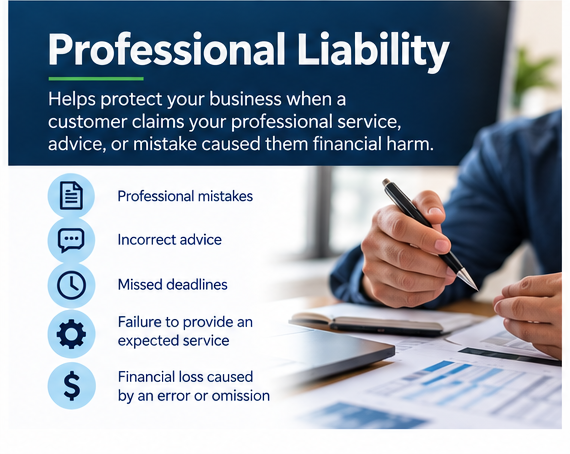
Professional Liability is different.
It is designed for claims arising from the professional services your business provides.
It may also be called:
Professional Liability is different.
It is designed for claims arising from the professional services your business provides.
It may also be called:
Errors & Omissions Insurance—or E&O.
Utah insurance guidance describes Professional Errors and Omissions Liability as coverage for liability arising from the performance of professional or business-related duties, with coverage tailored to the particular profession.
Examples can include allegations that your business:
Made a professional mistake
Gave incorrect advice
Failed to provide an expected service
Missed an important deadline
Failed to meet professional standards
Caused a customer financial loss because of an error or omission
Professional Liability is especially important for businesses that sell their knowledge, advice, expertise, or professional services.
General Liability May Not Cover a Professional Mistake
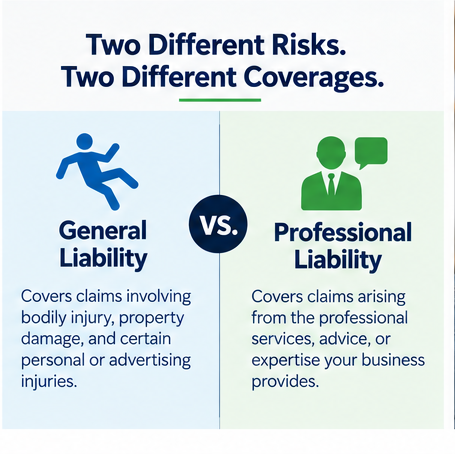
This is where business owners can get caught off guard.
A business may have excellent General Liability coverage and assume:
“If someone sues my company, I'm protected.”
But General Liability does not cover every type of lawsuit.
The NAIC specifically notes that standard Commercial General Liability does not cover professional liability claims involving errors or omissions, inappropriate advice, or failures in professional services.
Imagine an IT consultant recommends a system configuration for a customer.
The recommendation causes the customer's business systems to fail, resulting in a significant financial loss.
There may be no physical injury and no traditional property damage.
A General Liability policy may not be designed for that type of claim.
Professional Liability may be the more relevant coverage.
Who Should Consider Professional Liability?
Professional Liability is not just for doctors and attorneys.
Businesses that provide specialized services, advice, designs, recommendations, or expertise may have professional liability exposure.
Examples may include:
Consultants
Accountants
Insurance agents
Real estate professionals
Architects
Engineers
Technology companies
Marketing professionals
Financial professionals
Other professional service businesses
Utah's insurance classifications specifically identify professions such as accountants, architects, engineers, insurance agents and brokers, lawyers, real estate agents, and others as examples of businesses that may use Professional Errors and Omissions coverage.
Different professions can require very different Professional Liability policies, so coverage should be matched to the actual services the business performs.
What If Your Business Needs Both?
Many businesses do.
Consider a contractor who also provides design or consulting services.
If the contractor accidentally damages a customer's property while working, General Liability may be important.
But if the customer alleges that a design recommendation or professional service caused them a financial loss, Professional Liability may be needed.
Or consider a technology consultant.
Someone could slip and fall in their office—a General Liability exposure.
But the consultant could also make an error during a project that allegedly costs the client thousands of dollars—a Professional Liability exposure.
Having one does not automatically replace the need for the other.
Ask Yourself Two Questions
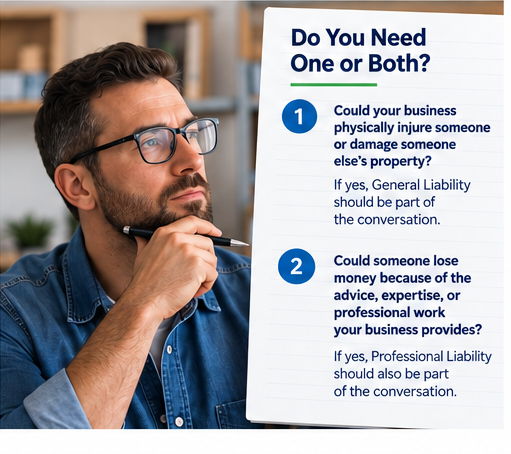
When reviewing your business insurance, ask:
Could my business physically injure someone or damage someone else's property?
If yes, General Liability should be part of the conversation.
Then ask:
Could someone lose money because of the advice, expertise, service, or professional work my business provides?
If yes, Professional Liability should also be part of the conversation.
For many businesses, the answer to both questions is yes.
One Policy Does Not Cover Every Business Risk
Business insurance works best when the coverage matches what the business actually does.
General Liability and Professional Liability solve different problems.
At Tommy Thomsen Insurance, we can review your operations, the services you provide, and the risks your business faces to help determine what types of liability protection may make sense.
Let’s Review Your Business Insurance
If you are not sure whether your business needs General Liability, Professional Liability, or both, let us take a look.
Request a business insurance quote through our website or call Tommy Thomsen Insurance at 801-982-7200.
We will explain the differences in plain language and help you build coverage around the way your business actually operates.
This article provides general insurance information and is not legal or professional advice. Coverage, limits, deductibles, exclusions, eligibility, and claim payments vary by insurer, policy, profession, and circumstances of the claim.