Why You Should Have Your Own Life Insurance — Not Just Rely on Work-Provided Coverage

September is Life Insurance Awareness Month, which makes it a good time to ask a question many people never stop to consider: if something happened to you tomorrow, would the life insurance through your job actually be enough to protect your family?
For a lot of people, the honest answer is no. Employer-provided life insurance is a nice benefit, but it was never designed to be your whole safety net. Here's why relying on it alone can leave your family more exposed than you might think.
Coverage That Doesn't Follow You
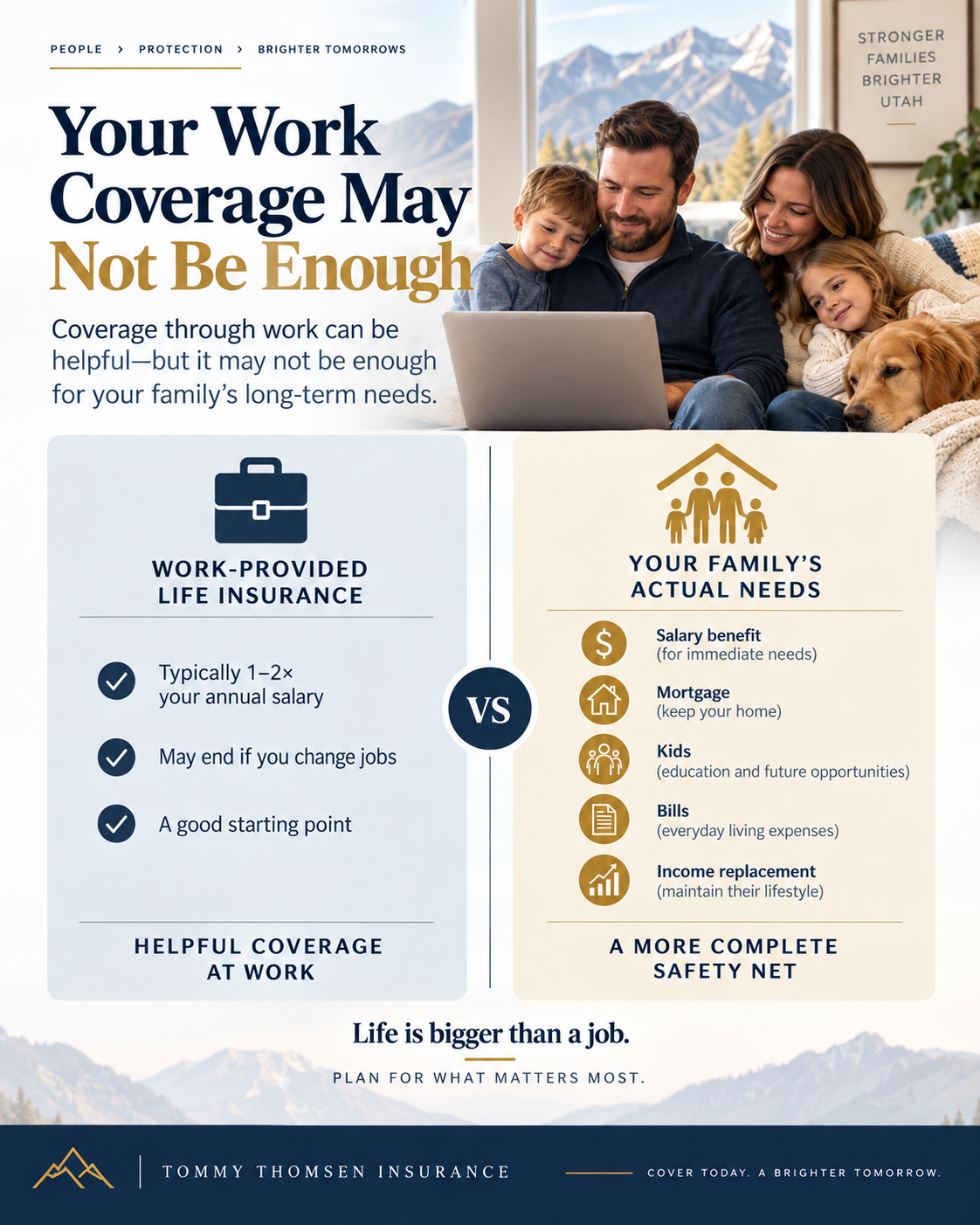
Here's the part that catches people off guard the most: employer-provided life insurance typically ends when your employment does.
That means if you:
Leave your job for a new opportunity
Get laid off
Retire
Become unable to work due to illness or injury
...your coverage can disappear right along with your paycheck — often at the exact moment your family can least afford to lose that protection. A policy you own yourself stays with you, regardless of where you work or whether you're working at all.
Consider a scenario like this: someone is diagnosed with a serious, terminal illness. As treatment intensifies, they're no longer able to keep working, so they leave their job during their final year.
Along with the paycheck, their employer-provided life insurance ends too — right as their family is preparing for the very situation that coverage was supposed to help with. Without a personal policy already in place, replacing that coverage at that point may be difficult or impossible, since new policies typically require proof of insurability that a serious diagnosis can disqualify. It's a difficult scenario to think about, but it's exactly the kind of gap a policy you own from the start is designed to prevent.
Group Policies Offer Limited Flexibility
Employer-sponsored life insurance is typically a one-size-fits-most benefit. That works fine for some, but it doesn't account for your specific situation — your mortgage, your number of dependents, your spouse's income, or your long-term financial goals.
An individual policy, on the other hand, can be tailored to you:
Coverage amount based on your actual financial obligations, not a flat multiple of salary
Policy length that matches your needs — like covering the years until your mortgage is paid off or your kids are through college
Type of policy (term or permanent) based on your budget and goals
Riders and add-ons for things like disability or critical illness, if you want them
You May Need to Prove Insurability Later — When It's Harder To

If you wait until you leave your job to think about life insurance, you may need to apply as an individual for the first time, often later in life or after a health change. Many personal life insurance policies are medically underwritten, meaning your age and health at the time of application affect your eligibility and your rate.
Buying a policy while you're younger and healthy generally means better rates and fewer complications. Waiting until you actually need to replace your work coverage — often during a stressful job transition — is the hardest possible time to be shopping for a new policy.
What "Enough" Coverage Actually Looks Like
There's no single right number, but a common starting point is to consider:
Outstanding debt — mortgage, car loans, credit cards, student loans
Income replacement — how many years of your income your family would need to maintain their lifestyle
Future expenses — childcare, college tuition, weddings, or other major costs down the road
Final expenses — funeral costs and any medical bills
Adding these up often reveals a number well beyond what a one-times-salary work policy provides.
Your Own Policy Is a Foundation, Not a Backup

Think of it this way: your work life insurance can be a nice supplement, but it shouldn't be the foundation your family's financial security rests on. A policy you own is one less thing tied to your job status, your employer's benefits decisions, or a layoff that's completely outside of your control.
Let's Make Sure Your Family Is Actually Covered

This Life Insurance Awareness Month is a good excuse to do something a lot of people put off: find out exactly what you have, and whether it's enough.
Not sure how your current coverage stacks up? Call Tommy Thomsen Insurance Agency in West Jordan, Utah at 801-982-7200. We'll walk through your situation, help you understand what your work benefits actually cover, and find a policy that protects your family no matter what happens with your job.
This blog post is for general informational purposes only and does not modify, replace, or guarantee coverage under any insurance policy. Life insurance eligibility, rates, and terms vary by carrier, age, health, and individual circumstances. Please contact Tommy Thomsen Insurance Agency at 801-982-7200 to discuss your specific coverage needs.