
Every holiday season, parents and grandparents ask the same question:
What do you give a child who already seems to have everything?
Toys get outgrown. Clothes stop fitting. Electronics become outdated.
But what about giving them something designed to still be there decades from now?
For some families, an Indexed Universal Life policy—or IUL—can be a way to give a child or grandchild permanent life insurance protection while beginning to build cash value at a very young age.
It is certainly not the traditional gift under the tree.
But that may be exactly what makes it worth considering.
Why Buy Life Insurance for a Child?
When we talk about life insurance on a child, the focus is usually very different from life insurance on a parent.
A child typically does not have an income that needs to be replaced.
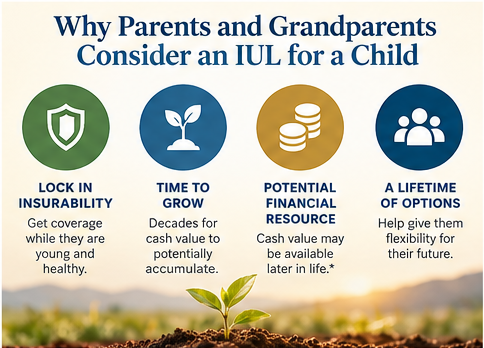
Instead, parents and grandparents may be thinking about the child's future.
The Utah Insurance Department specifically notes that some parents purchase life insurance on newborns so the child can have insurance in place if health problems develop later in life.
Think about what could happen over the next 20, 30, or 40 years.
A child who is healthy today could eventually develop a medical condition that makes purchasing new life insurance more expensive or difficult.
Having permanent coverage already in place can provide a foundation that began long before those future health questions existed.
Time May Be the Biggest Gift
One of the most interesting advantages of starting an IUL for a young person is simply:
Time.
An IUL is a form of permanent life insurance with a cash-value component. Interest credited to an IUL can be tied to an outside index such as the S&P 500.
Now imagine starting that policy when a child is 5 years old instead of waiting until they are 35.
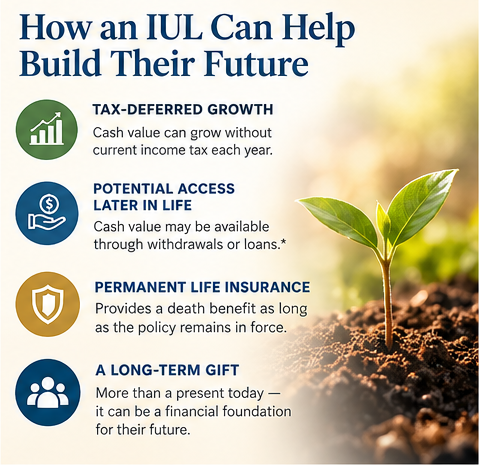
That potentially gives the policy decades to accumulate cash value.
Cash-value life insurance can build value that may later be accessed in several ways, including through policy loans. Utah's Life Insurance Buyer's Guide even identifies needs such as a child's tuition as one possible use for accumulated cash value.
The results are not guaranteed, and an IUL illustration should never be treated as a promise of future performance.
But starting earlier gives the policy something you cannot purchase later:
more time.
Imagine Starting When Your Grandchild Is Five
Imagine grandparents have a 5-year-old granddaughter.
Every Christmas they normally spend a few hundred dollars on toys and other gifts.
This year, they decide to do something different.
They help establish a permanent life insurance policy for her and begin funding it while she is young.
Over the years, the family continues contributing to the policy.
By the time she is an adult, she may have:
Permanent life insurance already in place
Years of accumulated policy history
Cash value that has had time to potentially grow
A financial resource that may be available later in life
Maybe someday she uses available cash value to help with college.
Maybe it contributes toward a first home.
Maybe she starts a business.
Maybe she simply keeps the policy growing for her own future family.
The important point is not predicting exactly what a 5-year-old will need at age 30.
The gift is giving them options.
The Cash Value Can Potentially Become a Resource Later

Like other cash-value life insurance, an IUL can accumulate value within the policy.
That cash value grows tax-deferred, meaning the policy owner generally does not owe current income tax every year simply because policy cash value increases.
Depending on how the policy is designed and maintained, cash value may later be accessed through withdrawals or policy loans.
That can potentially create a useful financial resource later in the child's life.
They Also Receive Permanent Life Insurance
The cash value gets a lot of attention, but an IUL is still life insurance first.
Assuming the policy remains properly funded and in force, it provides a death benefit.
Unlike term insurance, which provides coverage for a defined period, cash-value policies are designed to provide permanent coverage and may accumulate value over time.
For a young child, that can mean starting a permanent insurance foundation years before they have a mortgage, spouse, children, business, or other financial responsibilities.
Those needs may not exist today.
But someday they might.
What Happens When the Child Grows Up?
Depending on how the policy is established, a parent or grandparent may initially own and fund the policy while the child is the insured.
As the child becomes an adult, the family can review the policy, its ownership, beneficiaries, accumulated cash value, funding strategy, and long-term goals.
The exact ownership and transfer strategy should be discussed with the insurance company and appropriate tax or legal professionals because changing policy ownership can have tax and estate-planning consequences.
The goal is not simply to buy a policy and forget about it for 20 years.
It should grow and evolve with the person it was purchased to protect.
An IUL Is Not a Guaranteed Investment
This is important.
An IUL should not be sold as a guaranteed investment account.
Policy illustrations contain both guaranteed and nonguaranteed values. Actual cash-value growth can differ from an illustration based on credited interest, caps, participation rates, policy expenses, insurance charges, funding, loans, and other factors. Utah's Life Insurance Buyer's Guide specifically recommends understanding which values in an illustration are guaranteed and which are not.
An IUL also requires premiums and proper management to remain healthy over the long term.
That is why families considering one should understand:
How much they plan to contribute
What is guaranteed and what is not
How policy charges work
How indexed interest is calculated
How loans and withdrawals affect the policy
What could cause the policy to lapse
Who owns the policy
Who the beneficiaries are
A properly designed policy should be built around realistic expectations—not the highest numbers shown on an illustration.
A Different Kind of Holiday Gift
There will always be toys under the tree.
And there should be.
But parents and grandparents sometimes want to give something beyond what a child can open on Christmas morning.
An IUL can potentially provide a combination of:
Permanent protection.
Future insurability.
Cash-value accumulation.
Tax advantages.
Decades of time.
A child probably will not appreciate that gift at age five.
At 25, 35, or 45?
They may understand exactly what you gave them.
Give Them Something Designed for Their Future

If you are considering a different kind of gift for a child or grandchild this holiday season, we can show you how an Indexed Universal Life policy works and what it could look like over time.
At Tommy Thomsen Insurance, we can review policy illustrations with you, explain the guaranteed and nonguaranteed values, discuss different funding levels, and help you determine whether an IUL fits what you want to accomplish for your family.
Call Tommy Thomsen Insurance at 801-982-7200 or request a life insurance review through our website.
The best gift may not be something they use today. It may be something they are grateful you started years from now.
This article provides general insurance information and is not tax, investment, financial, or legal advice. Indexed Universal Life policies contain insurance costs, policy charges, and nonguaranteed elements. Cash-value growth, interest crediting, caps, participation rates, premiums, loans, withdrawals, death benefits, and tax treatment vary by insurer and policy. Policy loans and withdrawals can reduce cash value and death benefits and may create tax consequences if a policy lapses or is surrendered. Consult qualified insurance, tax, and legal professionals regarding your family's individual circumstances.